Traditional Carpentry
in Taroudant
A historical and technical guide to Taroudant woodworking, Saadian craft, and the living traditions of the Souss-Massa.
Traditional Taroudant Carpentry and Moroccan Woodworking History
This page focuses on the craft language of Taroudant: hand-carved cedar, Argan wood, painted Zouaq surfaces, and the role of the Mallem master craftsman in the Medina and around the Saadian Walls.
A Dialogue of
Twelve Millennia
Archaeological evidence of Neolithic pottery (10,000 BC) confirms that Moroccan craftsmanship predates the Islamic era by thousands of years, establishing a foundational visual language rooted in indigenous Amazigh identity.
Establishment of a foundational Berber visual language through geometric pottery and weaving.
Introduction of complex mineral pigments and the integration of Mediterranean maritime motifs.
Development of large-scale architectural timber use for gates and advanced structural beams.
The metaphysical concept of Tawhid (Unity) manifests through symmetry and sacred geometry.
A "Golden Age" of craftsmanship marked by perfected cedar carving and tin-glazed ceramic artistry.
Taroudant transformed into a military stronghold protecting the Maghreb's lucrative sugar trade.
The 7th-century arrival of Islam introduced the metaphysical concept of Tawhid (Unity), transforming carpentry into a form of sacred geometry. However, it was the Saadian Dynasty (16th C) that transformed Taroudant into an imperial stronghold, protecting the lucrative sugar trade with the most robust ramparts in the Maghreb.
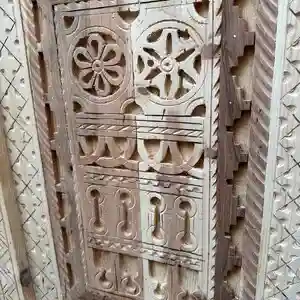
The Roudani School
The flow of artisans between Granada and Taroudant shaped our workshop's specific geometry.
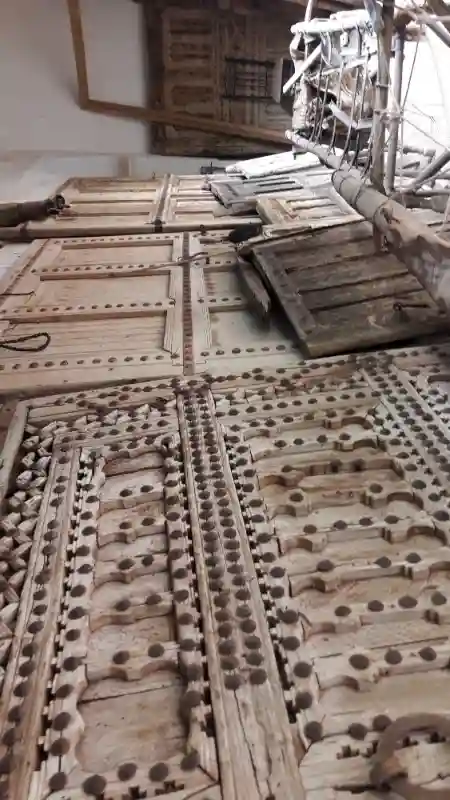
The Pentagon Ramparts
Taroudant's 8km perimeter is the third most robust historical fortification globally. Built using Pisé (rammed earth), these 10-meter high walls (up to 4m thick) feature over 100 defensive crenels. The city is accessed through five primary historical gates—masterpieces of Saadian military carpentry and trans-Saharan trade control.
Bab Zorgan
Named after the local mills (grinders) used for sugar cane and grain. This gate welcomed the massive gold and sugar caravans from the Sahara.
Bab Targhount
The "Gate of Conquest." Historically the primary sortie point for military campaigns and the Northern link to the High Atlas timber routes.
Bab Lkhmis
The "Thursday Market Gate." Features a massive 78sqm internal yard and small mosque for trans-Saharan caravan traders.
Bab Selsla
"The Gate of the Chain." Ceremonial entrance for Sultans with high-relief carvings and panoramic terrace views.
Bab Bounouna
Named for the Andalusian families who sought refuge here in the 16th century. Historically linked the medina to the fertile tanneries and gardens.
Assembly Without
Metallic Fasteners
"The wood must breathe to survive the Souss heat."
Authentic Roudani woodcraft is defined by Mechanical Assembly. We rely on physical joinery—Mortise, Tenon, and Dovetails—allowing the timber to breathe and expand without the need for chemical or metallic fasteners.
In our workshop, every cut is calculated using ancestral measurements—the Qid and Hasba—ensuring structural integrity for centuries.
Moucharaby Joinery
Passive cooling engineering. Individually lathe-turned spindles joined without glue, designed to facilitate evaporative cooling for the interior.
Ceiling Frameworks
Structural Muqarnas (stalactite) domes and heavy structural beams of Argan wood, historically used in Kasbahs for insect-resistance.
Tournage (Lathe Art)
Using the Arbalète (bow-lathe), our artisans turn Cedar, Walnut, and Olive with precision that modern industrial machinery cannot replicate.
Portals & Gates
Narrative carvings unique to the Souss region, depicting scenes of harvesting or protective Berber talismans like diamonds and stars.
The Carpenter's Tools (Al-Alat)
-
01
Al-Minshar (The Traditional Saw)
High-tension blade saws for precision cross-cutting of dense Atlas Cedar.
-
02
Al-Mabrad (The Rasp)
Used for the fine-tuning of joinery corners to ensure a vacuum-sealed fit.
-
03
Al-Qitâa (The Chisels)
Forged in the Souss-Massa region, these allow for the deep-relief carving characteristic of Saadian doors.
"Our math is not on paper; it is in the rhythm of the Menkach."
— Maâlem of the MedinaThe Language of the Door
In Taroudant, the door is a cultural text, blending Islamic abstraction with narrative Berber motifs.
Protective Totems
- Circles Unity & Deflection
- Eagles Saadian Military Power
- Diamonds Berber Fertility
- Zigzags Water & Life-flow
The Palette of Belief
- Red Guards against bad health
- White Wards off poverty
- Green Symbol of Fertility
- Yellow Wisdom & Turmeric
Tastīr Stars
Patterns are governed by the Ḥasba (calculation). The central "planetary" star, the Na'ora, radiates to infinity, often featuring 16 or 32-point configurations in monumental portals.
The Organic
Alchemy of Zouaq
The Maâlem avoids synthetic paints, preparing pigments from mineral and organic sources bound with heated "skin glue."
Indigo Blue
Derived from the Nila plant or copper sulphate.
Turmeric Yellow
Saffron powder mixed with pomegranate leaf.
Red Ocher
Combination of poppy powder and pomegranate peel.
Black Carbon
Charred sheep's wool mixed with skin glue.
Brushes are crafted from donkey mane hair, prized for their flexibility and steady pigment delivery.
Timber Specs
Atlas Cedar (Arz)
Pliable and naturally alkaline to repel parasites. The primary choice for Mashrabiya and monumental mosque doors.
Argan Wood
Density: 1.05 g/cm³. Endemic and indestructible by insects. Historically used for kasbah structural beams and heavy agricultural tools.
Thuya (Araar)
Rare aromatic burl grain from the Atlas foothills. Prized for reddish-brown burl grain and luxury inlays in high-end furniture.
Lemon & Lime
Dense hardwoods used for marquetry contrast. Lime wood is often "fried" in used cooking oil to achieve a deep black color for decorative strips.
The Roudani Lexicon
Tastīr
The intricate "lattice of the stars." A mathematical system where 8, 16, or 32-point stars form an infinite grid representing the unity of creation (Tawhid).
Tawrīq
Stylized floral and leaf patterns (Arabesque). In Taroudant, these motifs often include local botanical influences from the Souss valley.
Mashrabiya
Derived from "Sharaba" (drinking) and "Sharafa" (seeing). These screens facilitated evaporative cooling via water jars placed in the lattice window.
Tazouaqt
Traditional polychrome painting using Natural Pigments: Indigo (blue), Turmeric (yellow), Poppy (red), and charred wool (black), bound with skin glue and buffed with beeswax.
Heritage Maintenance
The conservation of Taroudant’s historic portals requires a deep understanding of environmental stressors. In the Souss region, the primary threat is thermal expansion.
| Maintenance Task | Traditional Material | Purpose |
|---|---|---|
| Nourishment | Linseed or Tung Oil | Prevents grain cracking (12-18 months) |
| Surface Seal | Organic Beeswax | Enhances grain and water resistance |
| Pest Prevention | Neem or Cedar Oil | Natural termite repellent |
The Henta System
Historically organized into a Henta (Guild), the craft is overseen by an Amin (Provost)—a guardian of quality and professional mediator.
1. The Maâlem (Master)
Achieving total mastery through formal apprenticeship. Denotes manual skill and the responsibility of transmitting ancestral knowledge.
2. The Transmission
A "Living Museum of Creativity" where knowledge is passed orally and tactilely. Math is taught through Hasba (physical measurements).
3. The Amin (Provost)
An eminent member selected for piety and expertise to act as the ultimate arbiter of the guild's technical and ethical standards.